CBD Bath Salts: Ingredients, Uses, and How to Choose a Product
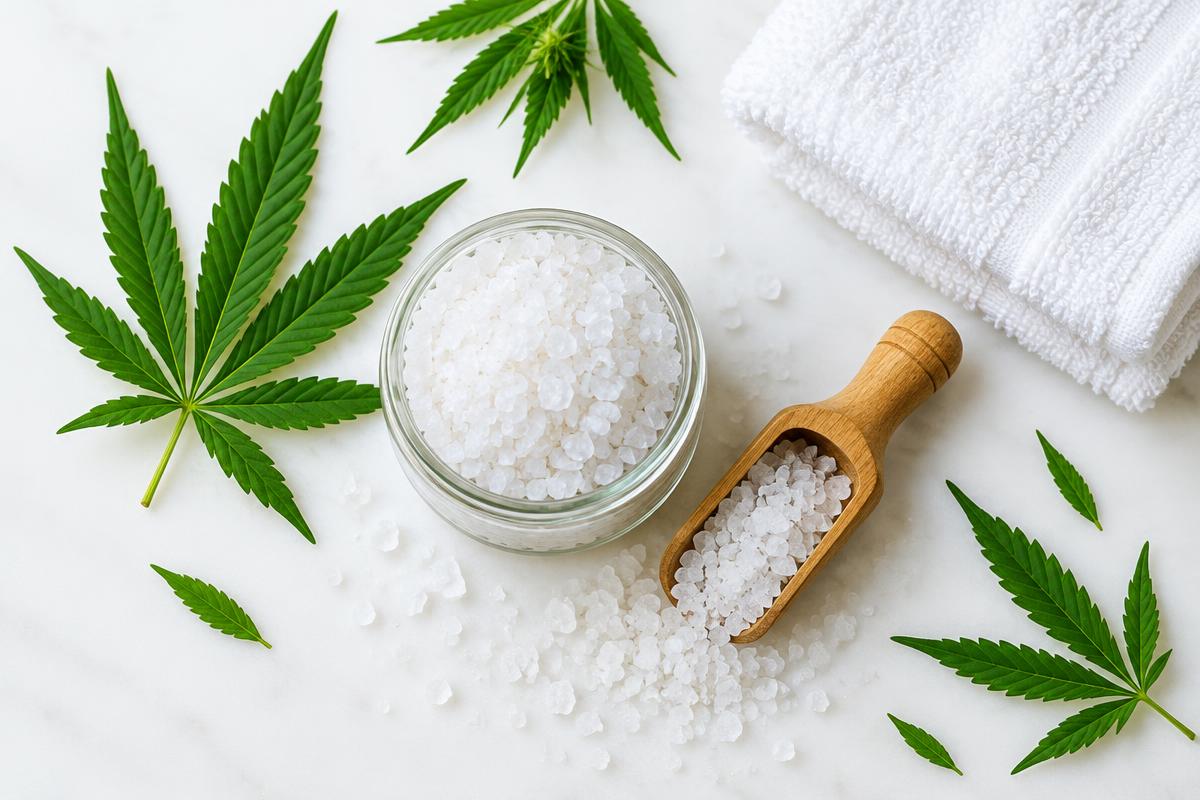
CBD bath salts are mineral bath soaks mixed with cannabidiol (CBD), a compound from the hemp plant. You pour a scoop into warm water, let it dissolve, and soak.
People like them for the same reason they like any bath soak. It's a simple way to unwind. Add CBD, and it feels like a more modern take on an old habit.
But labels can be confusing. Is it Epsom salt or sea salt? How much CBD is in a scoop? Does it do anything extra? In this guide, you'll learn about the main salt types, what else goes into these products, how to read a label, and how bath salts differ from bath bombs.
What Are CBD Bath Salts?
Bath salts are coarse or fine crystals you dissolve in a bath. Most are made from Epsom salt, sea salt, or a blend. Many also include oils, dried flowers, and scent.
CBD, short for cannabidiol, is one compound in the cannabis plant. It does not cause a high. THC does that. Most CBD products sold in the U.S. come from hemp, which has very little THC.
In CBD bath salts, the maker adds hemp extract to the salt blend. It's usually mixed with a carrier oil so it spreads through the crystals.
Quick note: these are not the "bath salts" you may have heard about in the news. Those are illegal street drugs with the same name. Real bath salts are just soaking products, and they're a different thing entirely.
What Types of Salt Are Used in Bath Salts?
The salt itself shapes how the product feels and what it contains. Here are the common ones.
Epsom salt. This isn't table salt at all. It's magnesium sulfate. It's the most common base for bath soaks. People often use it after workouts or long days on their feet. Many believe the magnesium absorbs through skin, but research on that is limited. A soak may feel good, but don't expect big claims to hold up.
Himalayan pink salt. This is sodium chloride with trace minerals that give it a pink color. It looks nice and dissolves well. The trace minerals are very small in amount.
Dead Sea salt. This comes from the Dead Sea and has more magnesium, potassium, and other minerals than regular sea salt. It's popular in spa products. It can also feel drying for some people.
Sea salt. This is basic salt from evaporated seawater. It's often used as a filler or blended with other salts.
Baking soda. Sometimes added to make water feel softer. It's not a salt, but you'll see it in some blends.
A good label tells you which salts are in the blend and roughly in what order. If a product just says "bath salts" and nothing else, that's not much to go on.
What Else Is in CBD Bath Salts?
Salt is only part of the formula. Check for these:
CBD extract. It may be listed as hemp extract, cannabidiol, full-spectrum hemp extract, or CBD isolate.
Carrier oils. Coconut, jojoba, sweet almond, and similar oils help mix the CBD in. They also leave a film on the tub.
Essential oils and fragrance. Lavender, eucalyptus, and chamomile are common. "Fragrance" or "parfum" can hide a long list of scent chemicals. These are a top cause of skin reactions in bath products.
Dried botanicals. Flower petals, herbs, and oats make the product look nice. Some can clog drains or irritate skin.
Colorants. Dyes and mica add color. They can also stain a tub.
If you have sensitive skin, shorter ingredient lists are easier to check and easier to avoid problem ingredients.
Full-Spectrum, Broad-Spectrum, and CBD Isolate
CBD bath salts come in three types of hemp extract.
| Type | What's in it | THC? |
|---|---|---|
| Full-spectrum | CBD plus other cannabinoids, terpenes, and plant compounds | Small amounts (federal limit for hemp is 0.3% THC) |
| Broad-spectrum | CBD plus other cannabinoids and terpenes, with THC removed | Usually none, but check the report |
| CBD isolate | Only CBD, purified | None, but check the report |
There's no solid proof that one type works better in a bath. The main difference is THC. If you take drug tests or want to avoid THC, broad-spectrum or isolate may suit you better. Even then, don't just trust the front label. Check the lab report.
How to Read a CBD Bath Salt Label
Here's what to look for, step by step:
- CBD amount. It should be listed in milligrams (mg). Check whether the number is per jar, per scoop, or per bath. A jar that says "500 mg CBD" with 10 baths per jar is about 50 mg per bath.
- Serving size. Look for a clear scoop size or amount per bath.
- Type of extract. Full-spectrum, broad-spectrum, or isolate.
- Salt types. The label should name them, like Epsom salt or Dead Sea salt.
- Full ingredient list. Look for fragrance, dyes, and essential oils if your skin is sensitive.
- Batch or lot number. You need this to match the product to its lab report.
- Lab report (COA). A Certificate of Analysis shows what an independent lab found. It should match your batch and show CBD, THC, and contaminant results.
- Directions and storage. Good brands tell you how much to use and how to keep the product dry.
- Health claims. Be careful if a label says the product treats or cures anything. That's a red flag.
Keep in mind that the CBD amount on the label tells you what's in the jar, not how much your body takes in. We don't know how much CBD gets through skin in a bath. Salts don't change that. CBD doesn't dissolve well in water, so much of it may float or cling to the tub. Some brands say their CBD is "water-soluble." If you see that claim, ask for proof. Don't take it for granted.
What Are the Possible Benefits?
There's very little research on CBD bath salts specifically. Most CBD research looks at oral products, and results from those don't carry over to bath products.
What we can say: warm baths can feel relaxing, and many people use bath salts as part of a wind-down routine. If you feel calmer after a CBD bath, it could be the warm water, the scent, the quiet time, or CBD. No one can say how much each one matters.
Treat CBD bath salts as a self-care product. They're not a treatment for pain, stress, sleep, or any health condition.
CBD Bath Salts vs. Bath Bombs
Both go in a warm bath. They're not quite the same.
| CBD bath salts | CBD bath bombs | |
|---|---|---|
| What they are | Loose mineral crystals | Pressed, fizzy balls |
| Main base | Epsom, sea, or Dead Sea salt | Baking soda and citric acid |
| How they work in water | Dissolve slowly, no fizz | Fizz and break apart |
| Extras | Oils, scent, dried botanicals | Oils, scent, color, glitter |
| Mess and tub stain | Less color, but oils can leave a film | Dyes and oils can stain the tub |
| Control over amount | Easy to scoop more or less | One bomb per bath |
| Evidence for CBD | Very limited | Very limited |
If you like a simple soak with mineral salts, bath salts are a good fit. If you want the fizz and fun, a bath bomb is the better pick. For more on those, read our guide to CBD bath bombs.
How to Use CBD Bath Salts
Follow the directions on your product first. In general:
- Run a warm bath. Not hot. Very hot water can dry your skin.
- Add the salts. Use the amount the label recommends. Pour them in while the water runs so they dissolve.
- Stir if needed. Some salts take a minute to dissolve.
- Soak for the time on the label. If none is given, 15 to 20 minutes is common for baths in general.
- Get out carefully. Oils make the tub slippery. Hold on to something.
- Rinse the tub. A quick rinse with warm water and a bit of dish soap clears oily residue.
- Moisturize after. Salt soaks can leave skin dry. Pat dry and use a simple moisturizer.
If your skin is sensitive, try a patch test first. Dissolve a pinch in water, dab it on your inner arm, and wait a day.
Are CBD Bath Salts Safe?
For most healthy adults, CBD bath salts are probably low risk. But a few things are worth knowing.
Skin irritation. Salt, fragrance, essential oils, and dyes can bother some people. Watch for redness, itching, or a rash. If that happens, rinse off and stop using the product.
Open cuts and broken skin. Salt can sting. Skip the soak if you have cuts, fresh shaving nicks, or irritated skin.
Dry skin and skin conditions. Salt can dry skin out. If you have eczema or another skin condition, ask your doctor first.
THC and product quality. Some CBD products don't match their labels. They may have more or less CBD than claimed, or THC when they say they have none. That's why lab reports matter.
Medications and health conditions. Oral CBD can interact with some medicines. We don't know whether bath products do. If you take prescription medicine or have liver problems, ask your doctor or pharmacist first.
Epsom salt and health conditions. If you have heart or kidney problems, or high blood pressure, check with your doctor before using strong salt soaks.
Pregnancy and breastfeeding. The FDA advises against using CBD during pregnancy or breastfeeding. If that's you, talk to a qualified healthcare professional first.
Kids and pets. Keep bath salts out of reach.
None of this is meant to scare you. These are simple steps, like testing any new skin product.
How to Choose a CBD Bath Salt Product
Use this checklist to compare options:
- Clear CBD amount in mg per scoop or per bath
- Named salt types, not just "bath salts"
- Full ingredient list you can read
- Third-party lab report (COA) that matches the batch
- THC information that matches what the label says
- Fragrance-free or lightly scented options if you have sensitive skin
- Brand transparency about where the hemp comes from
- Fair price per bath and per mg of CBD
- No unrealistic health claims
Frequently Asked Questions
- 1. What are CBD bath salts?
- They're mineral bath soaks, usually Epsom salt or sea salt, mixed with hemp-derived CBD, oils, and sometimes scent or dried flowers.
- 2. Do CBD bath salts have proven benefits?
- No. There's very little research on CBD bath salts. A warm bath can feel relaxing, but it's unclear how much of that comes from CBD.
- 3. Are CBD bath salts the same as the "bath salts" drug?
- No. The drug sold under that name is unrelated and illegal. CBD bath salts are a soaking product.
- 4. Which salt is best for CBD bath salts?
- There's no single best one. Epsom salt is the most common. Dead Sea and Himalayan salts are popular too. Pick based on your skin and your taste.
- 5. How much CBD is in bath salts?
- It varies a lot. Check the label for mg per scoop or per bath, not just per jar.
- 6. Can CBD bath salts make you feel high?
- Unlikely. CBD doesn't cause a high, and skin absorption of THC is generally low. Some products have small amounts of THC, so read the COA.
- 7. Can I use CBD bath salts every day?
- There's no research on daily use. Salt baths can dry out your skin, so start with occasional soaks and see how your skin reacts.
- 8. Are CBD bath salts better than bath bombs?
- Neither has proof of extra benefits. Salts are simple and easy to measure. Bombs are more fun. Choose what you enjoy.
- 9. Are CBD bath salts legal in the United States?
- Under current federal law, hemp-derived products with no more than 0.3% delta-9 THC are generally legal, and state rules vary. But a law signed in November 2025 changes the federal definition of hemp starting November 12, 2026, and it could affect some products, especially full-spectrum ones. Check current federal and state rules before you buy.
- 10. What should I look for in a CBD bath salt COA?
- Check that the lab is independent, the batch number matches your product, the CBD and THC amounts make sense, and there are results for contaminants like heavy metals and pesticides.
Final Thoughts
Before you buy CBD bath salts, check the salt types, the CBD amount per bath, the full ingredient list, and whether the brand shares a lab report that matches your batch.
Skip products with big health promises. And remember, the research on CBD bath products is still thin. A good bath soak is a nice reason to buy one on its own.
Want more ideas? Read our guide to CBD bath bombs, or check out our CBD foot soaks.
Sources
- U.S. Food and Drug Administration: "What You Need to Know (And What We're Working to Find Out) About Products Containing Cannabis or Cannabis-derived Compounds, Including CBD"
- U.S. Food and Drug Administration: Cosmetics Laws & Regulations
- National Center for Complementary and Integrative Health (NIH): "Cannabis (Marijuana) and Cannabinoids: What You Need To Know"
- "Quantification of Cannabis in Infused Consumer Products and Their Residues on Skin" (PMC9380210)
- UK Committee on Toxicity: "Potential risks from use of topically applied CBD-containing cosmetic products"
- The FDA Law Blog: "Changes to 'Hemp' Definition Set to Close the Farm Bill Loophole" (January 2026)